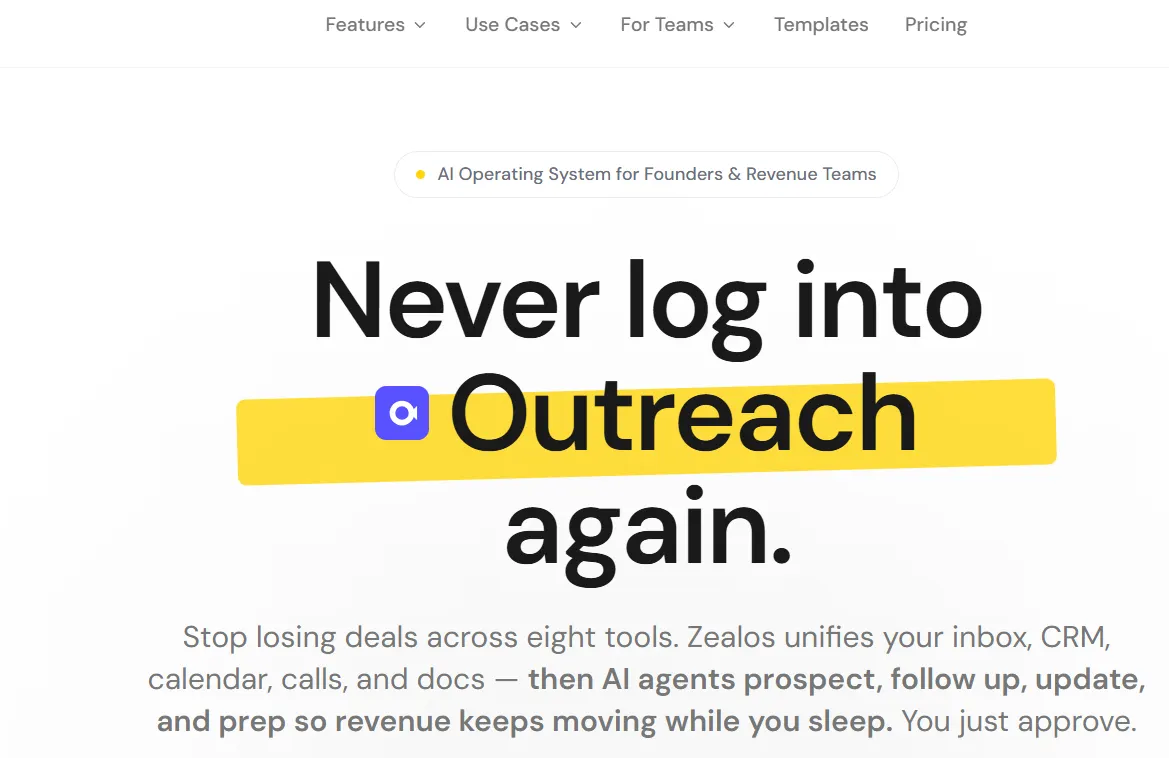
Zealos sells itself as an "AI operating system" for founders and revenue teams — one subscription that swallows your inbox, your CRM updates, your meeting prep, and your pipeline tracking. It's a big promise, and it comes with a real price tag. Here's what I found digging through its pricing, its integration list, and its short history, including a few things the marketing page doesn't put in front of you.
Zealos at a glance
- What it is: An AI layer that sits on top of Gmail, Slack, HubSpot and Salesforce, drafting emails, prepping meetings, and syncing CRM records automatically
- Who it's for: Small B2B revenue teams — founders doing their own selling, RevOps leads, and account executives
- Entry price: $49/user/month (Core), rising to $149/user/month (Execute)
- Free tier: None. 7-day free trial only
- Launched: April 2026 — this is a new product
- Independent reviews: None found on G2, Capterra, or Trustpilot at time of writing
What Zealos actually does
Strip away the "operating system" framing and Zealos is a workflow automation layer. It connects to the tools you already pay for — Gmail, Google Calendar, Slack, HubSpot, Salesforce, Notion, Zoom, LinkedIn, Stripe, Gong — then runs AI agents across the data those tools generate.
In practice that means four jobs. It triages your inbox and drafts replies. It builds a briefing document before each meeting by pulling context from your CRM and past threads. It writes CRM records after calls so you're not doing data entry at 7pm. And it watches for buying signals across connected accounts and ranks them.
That last one is the interesting part, and also the hardest to evaluate from the outside. "Buying signal detection" means different things at different companies. Some products mean a prospect visited your pricing page twice. Others mean genuine intent modelling across multiple data sources. Zealos's public material doesn't specify which, and that's the kind of gap you'd want to close during a trial rather than take on faith.
What it costs — the real numbers
Zealos publishes four tiers, priced per user per month:
| Plan | Price | AI credits | What it adds |
|---|---|---|---|
| Core | $49/user/mo | 2,500 | Unified inbox, email drafting, meeting prep, CRM sync, 20+ agents |
| Prospect | $99/user/mo | 6,000 | LinkedIn automation, multi-channel sequences, enrichment, buying signals |
| Execute | $149/user/mo | 12,000 | Live call assistant, conversation intelligence, forecasting, coaching |
| Enterprise | Custom | 25,000+ | SSO/SAML, custom roles, API access, dedicated CSM |
There's also an add-on called "AI Employees" — autonomous agents for business development, account management, or customer success — at $349/month per bot, with no cap on how many you add.
Run the arithmetic before you get attached to the idea. A five-person sales team on Core is $245/month, or $2,940/year. The same team on Execute is $745/month — just shy of $9,000/year. Add two AI Employees and you've crossed $17,000 annually. That is a serious line item for a startup, and it's worth being clear-eyed that this is not a cheap tool dressed up as one.
Watch the credit system
Every tier is metered in "AI credits" — 2,500 on Core, 12,000 on Execute. Zealos doesn't publish what a credit buys. One drafted email? One agent run? One meeting brief? The difference matters enormously: at 2,500 credits, a team doing heavy outbound could plausibly exhaust a month's allowance in the first week. Ask support for the credit consumption table before you commit, and watch your burn rate closely during the trial.
Two things worth knowing before you search for it
The price has moved sharply since launch. When Zealos appeared on launch directories in April 2026, it was listed at $29/month. Today the entry tier is $49/user/month. Some of that is early-adopter pricing expiring, which is normal. But if you read a write-up from spring 2026 quoting $29, that number is stale — and a product still repricing this aggressively three months in may reprice again. If budget predictability matters to you, factor that in.
There's a name collision. Search for this product and you'll also hit Zalos — a completely different company building AI agents for finance operations, which raised $3.6M in March 2026. Different product, different market, different founders. Several aggregator sites conflate the two. If you're reading funding news or reviews, check which company you're actually looking at.
The claims I couldn't verify
Zealos's homepage makes two specific numerical claims worth isolating, because they're doing a lot of persuasive work.
The first is that it replaces twelve tools worth $2,075/month for a five-person team, saving $21,960 a year. That framing only holds if you were genuinely paying for all twelve and can cancel all twelve. In most teams I'd expect real overlap — you're probably keeping your CRM regardless, and Zealos syncs to HubSpot and Salesforce rather than replacing them. So the honest version of that saving is smaller, and depends entirely on your existing stack. Price it against what you'd actually cancel, not against the vendor's list.
The second claim is 15+ hours saved per week per person. No methodology is published for that figure — no sample size, no measurement period, no description of how it was calculated. It should be read as marketing, not evidence. Fifteen hours is more than a third of a working week; a claim that large needs support that isn't currently public.
I want to be equally fair about the other direction: the absence of proof isn't proof of absence. These features may well work as described. The point is that right now there's no independent way to check, and you should structure your evaluation accordingly.
The real risk: it's a young product in a crowded category
Zealos launched in April 2026. That's the single most important fact in this write-up, and it cuts several ways.
New products in this category tend to ship fast and change often, which is genuinely good if you like influencing a roadmap. But it also means no track record on uptime, no history of how the team handles security incidents or breaking changes, no independent reviews, and real questions about whether a company this young will still exist in three years. You'd be routing your email, calendar, and CRM — effectively your entire revenue operation — through a startup with a few months of operating history.
That's not a reason to dismiss it. Every good tool was new once. But it changes what a sensible evaluation looks like: shorter commitment, closer monitoring, and a clear answer to "what happens to our workflow if this disappears?" Ask about data export before you sign, not after.
The category is also busy. Zealos competes with established conversation-intelligence tools like Gong and Clari on the forecasting and call side, with Apollo and Outreach on the sequencing side, and increasingly with HubSpot's and Salesforce's own native AI features — which are bundled into software you may already own. Its pitch is that owning the whole workflow beats stitching together point solutions. That's a real argument, but it's a bet on integration depth, and integration depth is exactly what a three-month-old product has had the least time to build.
Who this is plausibly right for
Based on what the product does and what it costs, Zealos makes most sense for a fairly specific profile:
- Small B2B teams where selling time is the bottleneck. If your AEs genuinely lose hours a day to CRM hygiene and inbox triage, the per-seat cost is defensible arithmetic.
- Founders doing their own sales. One person wearing five hats is the case where consolidation helps most, and where $49/month is easiest to justify.
- Teams already on HubSpot or Salesforce plus Gmail and Slack. The integration list is strongest here. If your stack sits outside it, much of the value evaporates.
And who should probably skip it:
- Solo founders pre-revenue. $49/month to automate a pipeline you don't have yet is premature. Free CRM tiers will serve you better until volume justifies the spend.
- Teams needing compliance guarantees today. SSO/SAML is Enterprise-tier only, and there's no published security certification history. Regulated industries should wait.
- Anyone who can't absorb a mid-contract price change. Given the move from $29 to $49 in three months, budget accordingly.
How I'd evaluate it during the trial
Seven days is short, so go in with a plan rather than clicking around. Five things I'd want answered before the trial expires:
- Burn one day of normal volume and check credit consumption. Extrapolate to a month. This is the fastest way to find out whether your tier is realistic.
- Test CRM sync on messy data, not clean data. Duplicate contacts, half-filled records, non-standard fields. Sync quality is where these tools usually break.
- Read the drafted emails critically. Would you actually send them without editing? If every draft needs a rewrite, the time saving is imaginary.
- Ask support a hard technical question — the credit table, or data export format. Response quality from a young company tells you a lot about the next two years.
- Confirm the exit path. How do you get your data out, in what format, and does anything break in your CRM if you cancel?
The bottom line
Zealos is doing something reasonable: revenue teams really do lose time to tool sprawl and manual CRM work, and an AI layer that genuinely absorbed that work would be worth paying for. The integration list is broad, the tiering is legible, and the pricing is published openly, which is more than a lot of tools in this space manage.
What's missing is evidence. No independent reviews, no methodology behind the headline savings claims, no published detail on the credit system that governs what you actually get, and only three months of operating history. That combination doesn't make it a bad product — it makes it an unproven one, and those are different things that marketing pages work hard to blur.
If the profile above fits you, the seven-day trial costs nothing but attention, and the checklist above will tell you more in a week than any article can. If it doesn't fit, this is an easy pass for now — and worth revisiting in a year when there's a track record to look at.
Frequently asked questions
Does Zealos have a free plan?
No. There's a 7-day free trial, after which all plans are paid, starting at $49/user/month. There is no permanently free tier.
Does Zealos replace my CRM?
No — it syncs with HubSpot and Salesforce rather than replacing them. Budget for both. This matters when evaluating the "replaces 12 tools" savings claim, since your CRM likely isn't one of the twelve you can cancel.
What are AI credits and how many do I need?
Credits meter your AI usage, from 2,500/month on Core to 12,000 on Execute. Zealos doesn't publish what individual actions cost in credits, so there's no way to size your tier accurately in advance. Track consumption during the trial and ask support for the consumption table.
Is Zealos the same company as Zalos?
No. Zalos is a separate company building AI agents for finance operations, which raised $3.6M in March 2026. The similar names cause frequent confusion in search results and aggregator listings.
How does it compare to Gong or Apollo?
Gong is stronger and far more established on conversation intelligence and forecasting; Apollo and Outreach are more mature for prospecting and sequencing. Zealos's argument is breadth — one tool across the whole workflow instead of three. Whether that beats best-in-class point solutions depends on how deep its integrations actually run, which is the main thing to test during a trial.