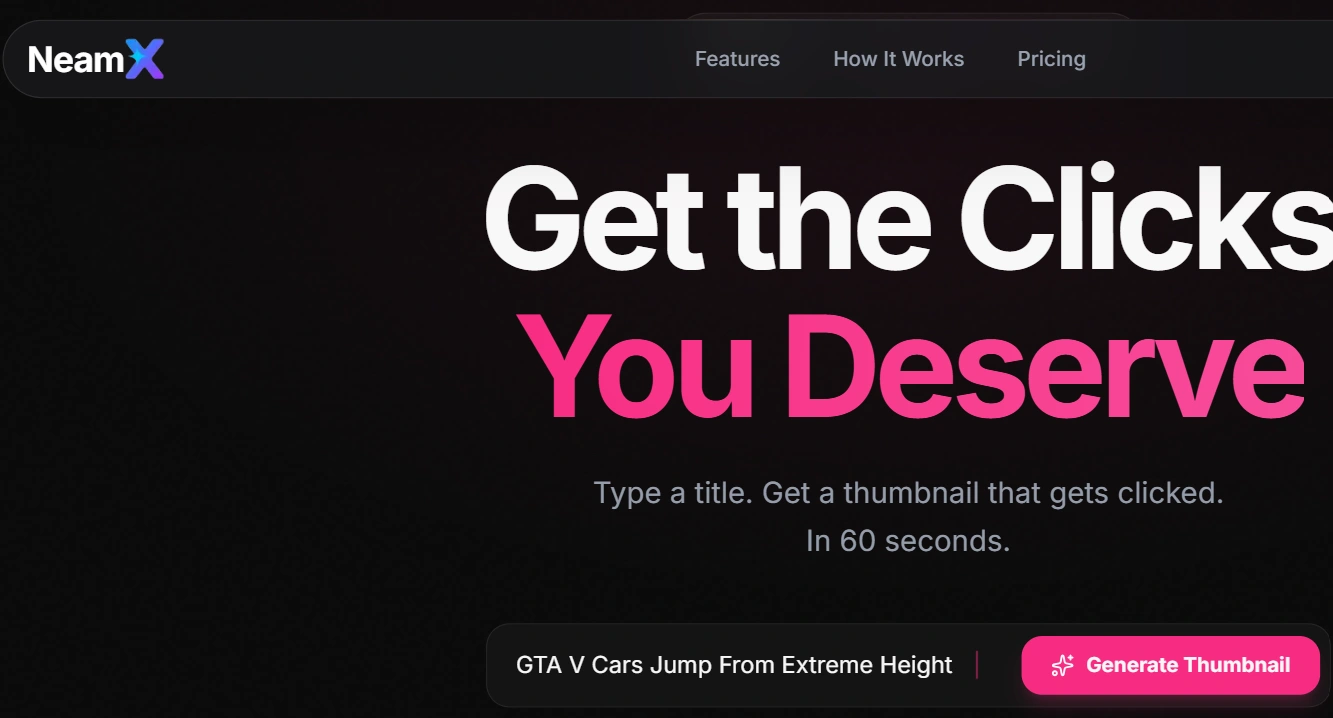
NeamX generates YouTube thumbnails from a video title in under sixty seconds. Type the title, get click-optimised designs at 1280×720, ready to upload. Upload a selfie and your face appears in them. Upload your existing thumbnails and it learns your channel's look.
It's a well-built tool aimed at a real problem. But there's a mismatch at the heart of how it's sold that's worth understanding before you buy, because it changes how you should use it: NeamX optimises for clicks, and YouTube no longer decides winners on clicks.
Here's what it costs, what it does well, and the free YouTube feature that should be part of your workflow regardless of whether you buy this.
⚡ The short version
- What it is: AI YouTube thumbnail generator — title in, finished thumbnails out.
- Price: one-time packs, ₹999 / ₹1,999 / ₹4,999. Not a subscription.
- No free tier and no trial — you pay before seeing a single output.
- Best features: face integration and style matching from your existing thumbnails.
- Use with: YouTube's free Test & Compare, which is what actually tells you if a thumbnail works.
What it costs
NeamX sells one-time credit packs rather than a subscription, which is unusual in this category and genuinely welcome — no recurring charge to forget about.
| Plan | Price | Thumbnails | Faces | Styles | Parallel |
|---|---|---|---|---|---|
| Basic | ₹999 (from ₹1,499) | 100 | 1 | 1 | 1 |
| Plus | ₹1,999 (from ₹2,999) | 200 | 3 | 3 | 3 |
| Pro | ₹4,999 (from ₹7,499) | 500 | 5 | 6 | 6 |
All tiers include editing, enhancement, AI keyword and title generators, multi-language support, private thumbnails, a commercial licence, and priority support. Payment is by UPI, cards, or net banking.
Work out the per-thumbnail cost and Basic lands at roughly ₹10 each, Plus at ₹10, Pro at ₹10. The pricing is essentially linear — higher tiers don't buy cheaper thumbnails, they buy more custom faces, more saved styles, and more parallel generations. So the question isn't volume economics, it's whether you need multiple faces and styles, which mainly matters if you run several channels or a channel with multiple presenters.
One caution: generation count is not the same as usable thumbnails. AI image tools require iteration, and a realistic hit rate might be one keeper in five to ten attempts. On that basis, 100 generations is perhaps 10–20 publishable thumbnails. Budget accordingly rather than assuming 100 videos' worth.
The metric problem: clicks aren't the goal
This is the part I'd most want a creator to understand, and it's why "click-optimised" is a slightly outdated pitch.
For years, thumbnail advice was all about click-through rate. Typical CTR benchmarks still hold as a diagnostic — roughly 4–8% is normal for an established channel, 10%+ is strong, and under 2% signals a genuine thumbnail problem. Systematic thumbnail testing can lift CTR by 20–40%.
But when YouTube built its own thumbnail A/B testing tool, it deliberately did not judge by CTR.
This is the trap with any tool that promises "the clicks you deserve." An aggressive, high-contrast, shocked-face thumbnail will reliably out-click a restrained one. If the video doesn't deliver what that thumbnail implied, viewers leave in the first thirty seconds, and YouTube reads that as a signal the video disappoints people it recommended it to. You've bought clicks at the cost of distribution.
So the correct way to use a generator like NeamX is not "make the most clickable thumbnail." It's "make several honest thumbnails that accurately represent the video, then let YouTube tell you which one holds attention." Which leads to the thing you should be doing regardless.
Use YouTube's free A/B testing — it's the missing half
YouTube's Test & Compare feature lets you run up to three thumbnails against each other on a real video with real traffic, and it decides the winner on watch time share. It's built into YouTube Studio and it costs nothing.
This is what makes a bulk generator genuinely useful rather than a guessing machine. On its own, NeamX produces variants and you pick one based on instinct. Paired with Test & Compare, you produce three variants and let actual audience behaviour decide. That's the difference between having opinions about thumbnails and having evidence.
A practical note on testing: you need roughly 2,000+ impressions before a result means anything. Small channels will find tests inconclusive on low-traffic videos, which is worth knowing before you read too much into an early result. And test one variable at a time — if two thumbnails differ in face, text, and background simultaneously, a win tells you nothing about why.
If you take one thing from this review: set up Test & Compare before you spend anything on thumbnail generation. It's free, it's the measurement layer, and without it you can't tell whether a paid tool improved anything.
What NeamX genuinely does well
Face integration is the standout. Upload a selfie and your face is composited into generated thumbnails. This solves the real problem with generic AI image tools for YouTube: thumbnails featuring the actual creator consistently outperform faceless ones, and no general-purpose generator can put you in the frame. For a creator-led channel this is the feature that justifies the category.
Style matching is smart product design. Upload your existing thumbnails and it learns your channel's visual language. Channel consistency matters more than most creators realise — a recognisable look means returning viewers identify your video in a crowded feed before they've read the title. A tool that maintains your look rather than imposing a generic one is doing the right thing.
Speed is real. Under sixty seconds from title to finished 1280×720 image. For creators publishing frequently, thumbnail production is a genuine bottleneck, and compressing it from an hour in Photoshop to a minute changes the publishing rhythm.
Conversational editing — asking for bigger text or a different background colour in plain language — removes the design-skill barrier that stops many creators iterating at all.
The commercial licence is included on every tier, which matters and isn't universal. Some free image tools restrict commercial use, and a monetised YouTube channel is commercial use.
The homogenisation risk
NeamX advertises that its AI is trained on viral thumbnails from top creators in each niche. That's a reasonable pitch and it carries a real cost worth naming.
A model trained on what already worked produces variations on what already worked. When thousands of creators use tools trained on the same corpus of successful thumbnails, the output converges. Everyone's thumbnails start looking like everyone else's — same arrow placement, same colour grading, same expression, same layout logic.
The irony is direct: a tool designed to make you stand out, used at scale, makes everyone blend in. And audiences are getting noticeably better at spotting AI-generated imagery, with a growing segment actively put off by it.
Practical implication: use the style-matching feature seriously rather than accepting default outputs. The value here is in speed and iteration on your established look, not in adopting a generic viral aesthetic that a thousand other channels are also adopting this month.
The no-free-tier problem
NeamX offers no free tier and no trial. You pay ₹999 minimum before seeing a single output.
For an AI image tool, that's a meaningful barrier, and not simply because of the money. Output quality in this category depends heavily on inputs you can't assess in advance — how well the model handles your face, your niche, your style references. Two creators can have completely different experiences with the same tool. A trial isn't a nicety here; it's the only way to know whether the thing works for you specifically.
Compare the alternatives: Canva has a substantial free tier, YouTube's Test & Compare is free, and most AI image generators offer some free generations. NeamX asking for payment first puts the risk entirely on you.
The mitigating factor is that ₹999 is a genuinely low entry price, and one-time rather than recurring — a bad outcome costs you ₹999 once, not an ongoing subscription you forget to cancel. If you publish regularly and thumbnails are a bottleneck, that's a defensible gamble. If you're an occasional creator, the risk-reward is worse.
I'd also note NeamX reports 550,000+ users across 20+ countries since June 2025. That's a company claim rather than verified data, but it does suggest the product isn't abandoned.
What else you could use
| Option | Cost | Best for |
|---|---|---|
| NeamX | ₹999 one-time | Fast bulk variants with your face composited in |
| Canva | Free tier / Pro | Manual control, templates, no AI dependency |
| YouTube Test & Compare | Free | Deciding which thumbnail actually works |
| Photoshop / Affinity | Subscription / one-time | Full control if you have the skills |
| A freelance designer | ₹500–2,000 each | Channels where thumbnails are the differentiator |
Worth being honest about Canva: for many creators it's genuinely sufficient. If you have a template you like and just swap the image and headline each week, you don't need AI generation at all. The case for NeamX is specifically about volume of variants and face compositing — if neither is a problem you have, save your money.
One policy note
YouTube's policies prohibit misleading thumbnails — images that misrepresent the content of the video. Enforcement ranges from reduced distribution to strikes.
This matters with any "click-optimised" generator, because the aesthetic that maximises clicks trends toward exaggeration: shocked expressions, dramatic implications, imagery suggesting something more extreme than the video delivers. A tool that generates that style will happily generate it for a video that doesn't earn it.
Keep thumbnails accurate to the content. It's the policy-safe choice, and given that YouTube judges on watch time, it's also the choice that performs better.
Who should buy it
Good fit: creator-led channels publishing weekly or more, where your face should be in the thumbnail and production time is a real constraint. Creators with no design skills who currently ship weak thumbnails or skip them. Multi-channel operators or teams with several presenters — the higher tiers' multiple face and style slots are aimed squarely at you. Anyone whose CTR sits below 2%, which indicates a genuine thumbnail problem worth spending on.
Poor fit: occasional publishers, where ₹999 for capacity you won't use makes little sense. Creators who already have a working Canva template and decent CTR — don't fix what isn't broken. Channels whose thumbnails are a core part of their brand identity, where a designer or your own hand will beat generated output. And anyone unwilling to use Test & Compare, because without measurement you're just generating more options to guess between.
Thumbnails are half the decision
Worth stating plainly, because tools in this category sell as though the thumbnail is the whole battle: a thumbnail and a title are read together, and testing one while ignoring the other wastes most of the available gain.
Viewers process both in roughly the same glance. A thumbnail that duplicates what the title already says wastes the opportunity — if the title names the subject, the thumbnail should supply the emotional or visual hook rather than repeating the words. The strongest combinations are complementary, where each half carries information the other does not.
This matters for how you use a generator. NeamX produces thumbnails from your video title, which means its output is by construction derived from the title rather than complementary to it. That is convenient and it is also a limitation worth compensating for deliberately — look at the generated result next to your actual title and ask whether they are saying the same thing twice. If they are, change one of them.
Frequently Asked Questions
What is NeamX?
An AI YouTube thumbnail generator. You enter a video title and it produces click-optimised thumbnails at 1280×720 in under a minute. It can composite your face into designs and match the style of your existing thumbnails.
How much does NeamX cost?
One-time packs rather than a subscription: ₹999 for 100 thumbnails, ₹1,999 for 200, and ₹4,999 for 500. Higher tiers add more custom faces, saved styles, and parallel generations. All tiers include a commercial licence.
Is there a free trial?
No, and it's the tool's biggest weakness. You pay at least ₹999 before seeing any output, and AI image quality varies a lot depending on your face, niche, and style references. The low one-time entry price partly offsets the risk.
Will better thumbnails increase my views?
They can, but clicks alone aren't the goal. YouTube's own A/B testing judges thumbnails by watch time share rather than click-through rate, because clicks that don't convert to watch time hurt a video's distribution. Aim for accurate and appealing, not maximally clickable.
What's a good YouTube CTR?
Roughly 4–8% is typical for an established channel, above 10% is strong, and under 2% suggests a real thumbnail problem. Treat it as a diagnostic rather than a target — a high CTR with poor retention is worse than a moderate CTR with strong watch time.
How many thumbnails do I actually get?
Fewer usable ones than the headline number suggests. AI generation needs iteration, so a realistic hit rate is one keeper per five to ten attempts. Treat 100 generations as roughly 10–20 publishable thumbnails.
Can I use the thumbnails commercially?
Yes — a commercial licence is included on every tier, which covers monetised channels. That's worth noting because some free image tools restrict commercial use, and a monetised YouTube channel counts as commercial.
Is Canva good enough instead?
For many creators, yes. If you have a template you like and swap the image and headline each week, you don't need AI generation. NeamX's case rests on producing many variants quickly and compositing your face — if neither is a bottleneck for you, Canva's free tier is sufficient.
Verdict
🏆 Our Assessment: NeamX
A capable thumbnail generator with two genuinely useful features — face compositing and style matching from your existing work — at a fair one-time price. Held back by no trial, which matters more than usual in a category where results vary by person. And "click-optimised" is the wrong target: YouTube judges thumbnails on watch time, not clicks.
What I'd actually do, in order. Turn on YouTube's Test & Compare first, because it's free and it's the only thing that tells you whether any thumbnail change worked. Establish your current CTR as a baseline. Then, if thumbnails are genuinely a bottleneck and you publish often enough to use the capacity, ₹999 is a low-risk one-time bet on speeding up production.
Use style matching rather than default outputs, keep thumbnails honest to the video, and let watch-time data rather than instinct pick the winner. Done that way, a generator is a useful accelerator. Done the other way — chasing maximum clickability — it's a fast route to a high CTR and a falling channel.
Running thumbnail tests on your own channel? I'd like to hear what actually moved the numbers — real before-and-after data from creators beats any tool review.