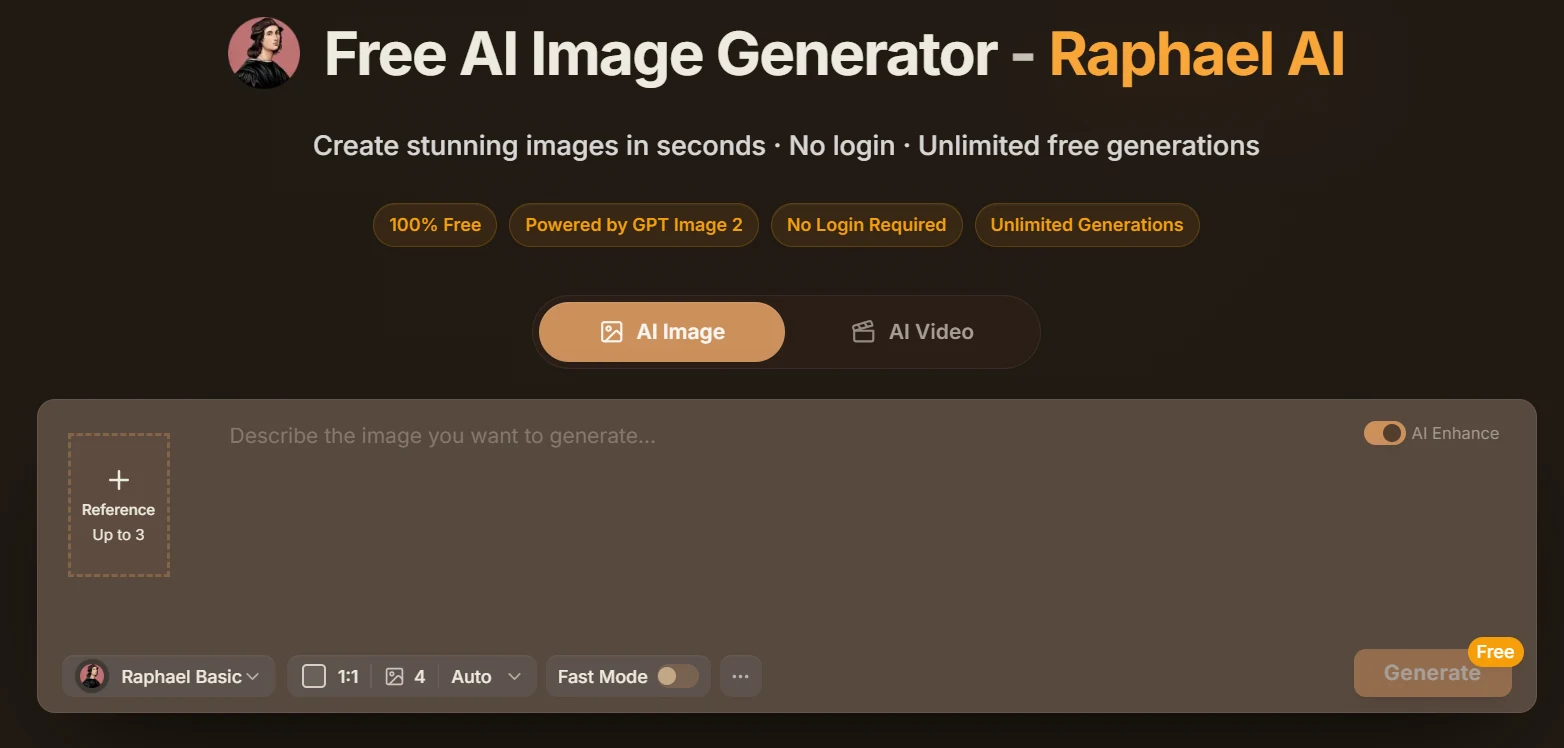
Raphael AI earned its reputation on a genuinely remarkable claim: the world's first completely free, unlimited, no-login AI image generator. No email, no credit card, no credits — just open raphael.app and generate. That was real, and it's why the tool spread the way it did.
It's also mostly historical. The product that exists today is a freemium service with a watermark on free output, a daily credit cap on the fast queue, and paid tiers at $10 and $20 a month. A lot of the coverage still circulating describes the older version. Here's what it actually is now, and whether it's still worth your time.
⚡ The short version
- Still free? Yes, genuinely — but watermarked, and capped at 10 fast-mode credits a day.
- The catch nobody mentions: free output is non-commercial only. No client work, no business blog, no products.
- Paid: $10/mo Pro (2,000 credits, no watermark, commercial rights), $20/mo Ultimate (5,000 credits).
- Still the best free option for: personal projects, learning prompting, throwaway concepts, mockups nobody publishes.
- Don't use it for: anything your business earns money from, unless you're on a paid plan.
What changed, and why it was always going to
The original Raphael was a side project with an unusually honest funding model. Its creator explained on Indie Hackers that they had idle A100 GPUs sitting unused at work, so they were only covering the electricity. That's it. That was the business model — spare capacity and a power bill.
It ran Flux.1-Dev, the full model rather than a cut-down variant, which is why output quality was surprisingly good for something free. At the time, nearly every other route to Flux — Fal, Together AI, Replicate — wanted an account and a card on file before you could generate anything.
Anyone who has ever paid a GPU bill could see where that ends. Free unlimited inference on borrowed hardware doesn't survive contact with real traffic. Today Raphael routes across several models — it advertises GPT Image 2, Seedream, Nano Banana, and its own Raphael 2.0 — behind a credit system with paid tiers. That's not a betrayal; it's what sustainability looks like. But it does mean the thing people recommend Raphael for no longer quite exists.
The licensing problem — read this part
This is the single most important fact about Raphael AI, and it's missing from almost every review of it.
Think about who the typical "free AI image generator" article is written for: bloggers, small business owners, social media managers, freelancers, e-commerce sellers. Nearly all of that is commercial use. A blog post with display ads on it is commercial. A client deliverable is commercial. A product listing is commercial. An Instagram post promoting your business is commercial.
So the honest framing is this: Raphael's free tier is excellent for learning, experimenting, and personal projects, and it is not a free image source for your business. If you're generating images that will earn you money, you need the $10 Pro plan — at which point compare it against everything else at that price, not against free tools.
Worth knowing too: the underlying Flux.1-Dev licence that powered the original version is itself restrictive and genuinely contested. A June 2025 revision removed the line permitting commercial use of outputs, and Black Forest Labs hasn't clearly resolved the ambiguity. Raphael's current lineup has moved on from Flux, but if you generated images there in the early days and put them to commercial use, that history is murkier than it looked at the time.
What the free tier actually gives you now
Two separate things get called "free" here, and conflating them is where confusion starts.
Fast mode: 10 credits per day. Roughly ten images, generated quickly, then you're done until tomorrow. This is the tier that behaves like a normal free plan.
Slow queue: unlimited. Raphael 2.0 on the slow queue has no daily cap. The tradeoff is wait time — anywhere from around 30 seconds to several minutes depending on how busy the service is. If you're not in a hurry, this is where the original "unlimited free" promise still lives.
Both carry a watermark. It sits in the lower-right corner at roughly 8% of the image height — small enough not to ruin a composition, obvious enough that you can't publish it as your own work without it reading as a tool demo. Free also includes around two video generations per day.
Worth knowing how the two queues feel in practice. The fast queue is quick enough to iterate against — you adjust a prompt, look, adjust again. The slow queue is a different working rhythm entirely: you're not sitting watching it, you're queuing something and coming back. Neither is better; they suit different tasks. Use the fast credits when you're still figuring out what you want, and the unlimited slow queue once you know and just need volume.
On the watermark: at roughly 8% of image height in the lower-right corner, it's placed to be survivable rather than ruinous. It won't wreck a composition and you can still judge the output quality underneath it. What it will do is make the image obviously unfinished to anyone looking — which is the point, and why it isn't a workaround for the paid tier.
What it costs
Verify current numbers on the official site before subscribing.
| Plan | Price | Credits | Commercial use | Watermark |
|---|---|---|---|---|
| Free | $0 | 10/day fast, unlimited slow queue | No | Yes |
| Pro | $10/mo or $120/yr | 2,000/mo (~400 videos) | Yes | No |
| Ultimate | $20/mo or $240/yr | 5,000/mo (~1,000 videos) | Yes | No |
Pro adds priority queue, all credit models, Raphael 2.0 Pro, and removes ads. Ultimate adds highest-priority queue, an instant AI photo editor, an Advanced Refine feature, full privacy, and early access to new features. There's no public API on any tier, which rules it out if you wanted to wire generation into an automated workflow.
The annual pricing is worth a glance: $120/year and $240/year are exactly 12× the monthly rate. There's no annual discount, so pay monthly unless you have a specific reason not to — you keep the flexibility for free.
Why "free forever" rarely survives
Raphael's history is a useful case study in the economics of free AI tools, and understanding it will help you predict what happens to the next one you come to depend on.
Image generation costs real money per image. Not much — fractions of a cent to a few cents depending on model and resolution — but it's a variable cost that scales directly with usage, which is fundamentally different from traditional software. A text editor with a million free users costs roughly what it costs with a thousand. An image generator with a million free users has a bill that grows every single day.
This is why "free and unlimited" in AI generation is nearly always a temporary state, and it fails in a predictable sequence: genuinely free and unlimited, then daily caps, then watermarks, then a paid tier with the free tier retained for acquisition. Raphael has walked that exact path, and it did so while being unusually honest about it — the founder openly described running on idle GPUs and covering electricity.
The practical lesson isn't cynicism. It's that you should hold free AI tools loosely. Don't build a workflow that only functions while something is free, don't assume this month's limits are next month's, and if a free tool becomes genuinely important to your work, either pay for it while you can or have a replacement in mind. That advice would have served Raphael's early users well, and it will serve you with whatever replaces it.
Getting real value from the unlimited queue
The uncapped slow queue is Raphael's most distinctive remaining feature, and most people misuse it by treating it like a fast tool that happens to be sluggish. It rewards a different working pattern entirely.
Batch your intent, not your clicks. Because you're waiting anyway, think properly about what you want before submitting rather than firing off a vague prompt and iterating in real time. The slow queue punishes reactive iteration and rewards deliberation.
Use it for volume, not for exploration. Once you know the style you want, the slow queue is an excellent way to produce many variations without a credit meter running. Use the ten daily fast credits for figuring out direction, then switch to slow for quantity.
Treat it as genuinely excellent prompting practice. This is the strongest case for Raphael in 2026. Learning to write good image prompts requires volume — hundreds of attempts, observing what phrasing shifts what. Every paid tool makes that expensive. An unlimited queue makes it free, and prompting skill transfers to every other generator you'll ever use. For someone learning, that transferability is worth more than the images.
Queue and walk away. Submit, do something else, come back. Waiting for a slow queue is the least productive thing you can do with the time, and treating it as asynchronous removes most of the frustration people report with it.
So is it still worth using?
Yes, but for a narrower set of things than its reputation suggests.
It's genuinely excellent for learning to prompt. The unlimited slow queue means you can iterate on prompt phrasing for hours without watching a credit balance drain. That's rare, and for someone building the skill it's more valuable than a handful of fast generations on a stingier free tier.
It's good for throwaway visual thinking. Concept sketches, mood exploration, "what would this look like" questions, mockups that exist only in a planning doc. The watermark doesn't matter if nothing gets published.
The no-login thing still counts. Not handing over an email to try a tool remains genuinely uncommon, and Raphael states it doesn't collect personal data or store your generated images. If you're privacy-conscious or just tired of signup flows, that's a real point in its favour.
Where it stops making sense is the moment output leaves your machine and touches anything commercial. At that point you're comparing a $10/month plan against a crowded field, and Raphael's distinguishing feature — being free — no longer applies.
What multi-model routing means for you
One consequence of Raphael's shift from a single Flux front end to a multi-model service deserves spelling out, because it changes how predictable the tool is.
When Raphael ran Flux.1-Dev exclusively, you knew precisely what you were getting. Prompting techniques that worked kept working, because the same model handled every request. Now that requests are routed across GPT Image 2, Seedream, Nano Banana, and Raphael 2.0, you have far less certainty about which model produced any given image.
That's a genuine trade rather than a straightforward downgrade. Routing means the service can send your request to whichever model handles that kind of image best, and it means the platform can adopt better models without you doing anything. The cost is reproducibility: the same prompt may not produce comparable results across sessions, and a technique you developed against one model may quietly stop working when routing sends you elsewhere.
Practically, this matters most if you need consistency across a set of images. If you're producing a series that must share a visual language, test whether you can actually achieve that before relying on it — and note that this is precisely the use case where a paid tool with an explicit model selector earns its money. For one-off images, routing is invisible and mostly beneficial.
What to use instead, depending on what you need
| If you need | Consider |
|---|---|
| Free images you can legally use commercially | Not this. Look at stock libraries with clear licences, or a paid generator where rights are unambiguous. |
| Highest raw image quality | Midjourney. Different league, and priced accordingly. |
| Editing and compositing control | Dzine or similar layer-based tools — Raphael is generation-only. |
| Unlimited free practice at prompting | Raphael's slow queue is genuinely one of the best options available. |
| API access for automation | Not Raphael — no public API. Use Replicate, Fal, or a model provider directly. |
One practical warning about free tools and client work
A pattern worth avoiding, because it catches people out repeatedly. You find a free tool, it works well, and it quietly becomes part of how you deliver work. Then the terms change, or a limit appears, or the licensing turns out to be narrower than you assumed — and now the problem is not that you need a new tool, it is that images already sitting on a client site were produced under terms you did not read carefully.
The fix is simple and takes two minutes. Before any generated image goes into work that earns money, write down which tool produced it and under what plan. If the licensing later turns out to be a problem, you will know exactly what to replace instead of guessing. This applies to every free generator, not just this one.
Frequently Asked Questions
Is Raphael AI still free?
Yes, and more generously than most — 10 fast credits daily plus an uncapped slow queue, with no login required. But free output is watermarked and restricted to non-commercial use, which is a significant change from how the tool was originally described.
Can I use Raphael AI images for my business?
Only on a paid plan. Raphael's terms permit commercial use for paid subscribers and limit free users to personal and non-commercial purposes. If images will appear on a monetised blog, a client project, a product listing, or business marketing, you need Pro or Ultimate.
Does free output have a watermark?
Yes. It sits in the lower-right corner at roughly 8% of image height — small enough not to wreck a composition, obvious enough that you can't pass the image off as your own finished work. Removing it requires a paid plan.
What model does Raphael AI use now?
It originally ran Flux.1-Dev. It now routes across several models including GPT Image 2, Seedream, Nano Banana, and its own Raphael 2.0. Which one handles your request depends on the platform's routing and your plan.
How slow is the free unlimited queue?
Typically around 30 seconds up to a few minutes, depending on traffic. Fast mode returns in roughly 8 seconds but is capped at 10 generations a day on the free plan.
Verdict
🏆 Our Assessment: Raphael AI
Still one of the most generous free image generators available, and still the best place to practise prompting without watching a credit counter. But the "free, unlimited, watermark-free" tool people recommend to each other stopped existing a while ago. Treat the free tier as a sandbox, not a supply of publishable images.
What I'd actually tell someone: use it freely for anything that stays private — learning, sketching, exploring ideas. The moment you want an image on something that makes money, stop and either pay the $10 or use a tool whose licensing you've read. The watermark is the visible limit; the licence is the one that matters.
One last practical note: a lot of advice about Raphael still circulating online describes it as unlimited and watermark-free. If you've been using it commercially on that basis, it's worth checking which images went where before someone else raises the question.
Spotted something here that's out of date? Let me know — this tool has changed once already and will likely change again.