Roughly 96% of B2B website traffic leaves without identifying itself. Someone reads your pricing page, compares your features, spends eight minutes deciding whether you're a fit — and vanishes. You know a visit happened. You have no idea who it was.
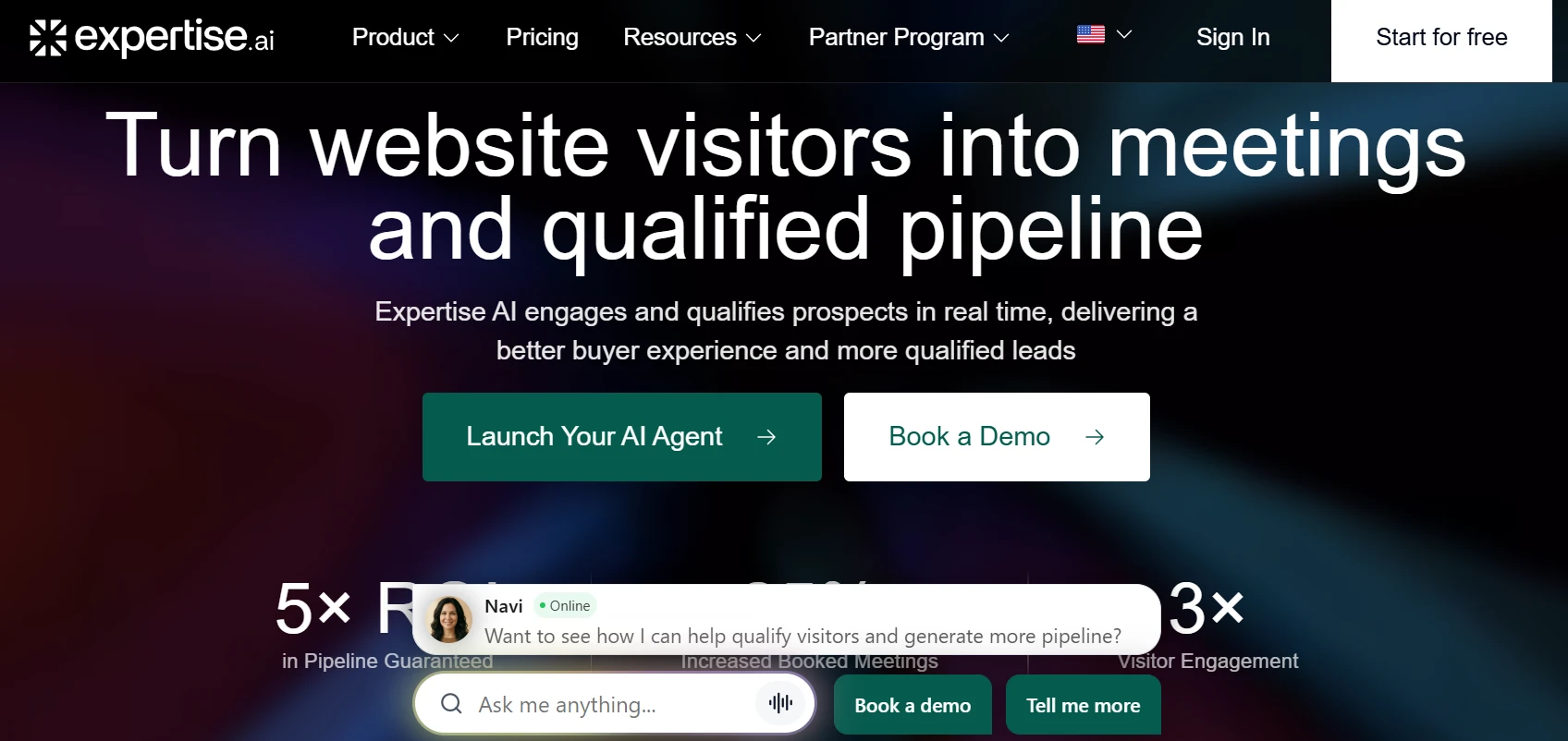
Expertise AI — the platform formerly known as Chatsimple — exists to close that gap. It identifies anonymous visitors, scores them on buying intent, engages them in conversation, and books meetings directly into your calendar without a salesperson involved.
It's a genuinely capable product addressing a real and expensive problem. It also raises a compliance question that its marketing doesn't foreground, and that question should shape how — and whether — you deploy it.
⚡ The short version
- What it is: an inbound AI sales agent — visitor identification, intent scoring, conversation, and meeting booking.
- Formerly Chatsimple; the company is still Chatsimple Inc.
- Pricing isn't public. Reported to start around $500/month. Expect a sales call.
- The critical issue: person-level visitor identification carries real legal exposure. Company-level is much safer.
- Best for: B2B teams with meaningful inbound traffic and a legal function to sign off deployment.
What it actually does
Expertise AI has repositioned as a broader go-to-market platform — installable "GTM skills" you deploy for specific plays — but the core capability that matters is the inbound loop, and it has four stages.
Identification. It resolves anonymous traffic to identities. Depending on configuration this ranges from the company a visitor works for through to individual-level detail — reportedly including names, email addresses, LinkedIn profiles, and company records.
Scoring. Visitors get an intent score, with the interface showing values across a 23–92 range, plus an ICP fit score. The intent is to separate a casual reader from someone who visited your pricing page three times this week.
Engagement. Rather than a passive chat widget waiting to be clicked, it proactively qualifies visitors in conversation — and does so across web chat, WhatsApp, Messenger, and Instagram.
Booking. Qualified conversations convert straight into calendar bookings without human handoff. This is the part that distinguishes it from a chatbot that collects an email and creates follow-up work for someone.
Integrations are extensive: native HubSpot, Salesforce, and a long list including Slack, Gmail, Apollo, Gong, Marketo, Outreach, Clay, Pipedrive, Intercom, and Zoom. HubSpot support is reported as the most mature, which matters if you're evaluating on integration depth.
The compliance question — read before you buy
This is the section I'd most want in front of anyone considering this category, because the distinction it turns on is not obvious and the consequences are real.
There are two very different things called "visitor identification," and they sit in different legal positions.
Person-level identification resolves traffic to a named individual — their name, email, LinkedIn profile. This is personal data. It typically requires consent or a carefully documented legitimate-interest assessment, and published guidance is consistent that this is where most violations occur.
Expertise AI's visitor intelligence is reported to capture person-level detail. That's the more powerful capability and the one carrying meaningfully more risk.
What that means practically:
Under GDPR, identifying named individuals without a lawful basis is the specific failure mode regulators act on. A legitimate-interest assessment needs to be documented before deployment, not reconstructed afterwards. Your privacy policy needs to disclose what you're doing in terms a visitor would actually understand.
Under US state law, the picture is messier rather than simpler. California, Colorado, Virginia, and Connecticut all operate opt-out rather than opt-in regimes, but they implement it in conflicting ways — California frames web tracking as a disclosure problem, Colorado as a technical enforcement problem, Connecticut as an experience problem. Compliance in one state doesn't give you compliance in the others. CCPA penalties run to $2,500 per violation, or $7,500 for intentional violations — and "per violation" in a tool processing every visitor is a number that scales badly.
None of this makes the product unusable. Plenty of companies run visitor identification lawfully. But it does mean three things should happen before you switch it on: get your legal or privacy function to sign off, document your lawful basis, and update your privacy policy. If you can't do those, run company-level identification only — you lose some precision and you remove most of the exposure.
I'd also ask the vendor directly what happens to identified-visitor data, where it's processed, and whether they'll sign a data processing agreement. Any serious vendor in this space will have clear answers.
Reading the performance claims
Expertise AI publishes some strong numbers: an 84% lift in chat-to-lead conversion, 9x ROI in pipeline within six months, and user reports that around 20% of AI conversations result in a booked meeting.
These are vendor figures, and worth reading with the right kind of scepticism — not dismissal, but attention to what they're measuring.
"84% lift in chat-to-lead conversion" is a relative improvement against an unstated baseline. If a passive chat widget converted 2% of conversations, an 84% lift takes you to 3.7%. That's a real improvement and a much smaller number than the headline implies. Always ask what the starting point was.
"9x ROI in pipeline" is measured in pipeline, not revenue. Pipeline is a forecast, not money. A meeting booked is not a deal closed, and the conversion rate from AI-booked meetings to closed business is the number that actually determines whether this pays for itself — and it isn't published.
"20% of conversations become meetings" is the most useful of the three, because it's a concrete operational figure. But it says nothing about the quality of those meetings. A meeting with someone who was never going to buy consumes an hour of a salesperson's time.
The evaluation question that matters isn't "does it book meetings" — it will. It's "what percentage of AI-booked meetings does my team consider worth having?" Ask for that number in a reference call with an existing customer, because it's the one that determines whether this creates pipeline or creates busywork.
What it costs
Pricing is not published on the site. Third-party sources report it starting around $500/month, with a free tier or no-credit-card signup available for evaluation.
Unpublished pricing usually means one of two things: pricing varies enough by deployment that a number would mislead, or the sales motion depends on qualifying you before quoting. Either way, expect a call rather than a checkout page.
At $500/month — $6,000 a year before implementation effort — the maths is straightforward. If your average deal is worth $10,000, the tool needs to generate roughly one additional closed deal a year to break even, and anything beyond that is margin. That's a genuinely achievable bar for a B2B company with real inbound traffic.
It's an obviously bad bar if your traffic is thin. This is the thing to be honest with yourself about: visitor identification multiplies existing traffic, it doesn't create it. Identifying 96% of a hundred monthly visitors gives you very little. The tool assumes you already have an inbound problem worth solving.
Where it fits, and what else to look at
The category has several distinct approaches, and they're not interchangeable:
| Approach | What you get | Compliance profile |
|---|---|---|
| Company-level identification (Leadfeeder, Leadinfo) |
Which organisations visited | Lower risk — generally not personal data |
| Person-level identification (Expertise AI, Warmly) |
Named individuals, contact details | Higher risk — needs consent or documented basis |
| Conversational qualification (Intercom, Drift) |
Engagement with self-identified visitors | Lower — visitor chooses to engage |
| Form optimisation | Better conversion of people already willing | Minimal |
Expertise AI's distinguishing feature is combining identification with autonomous booking — most competitors do one or the other. Identification tools hand you a list and leave the outreach to your team; chat tools engage visitors who raise their hand but can't tell you about the ones who don't.
Whether that combination is worth it depends on a question about your own operation: is your bottleneck knowing who visited, or acting on it? If your sales team already ignores the leads you generate, identification will produce a longer list to ignore. Fix the follow-up problem first — it's cheaper.
What to ask before signing
For a purchase at this level, these are the questions worth getting answered in writing:
- Can identification be restricted to company-level? Your legal team may require it, and you want to know it's configurable before you buy.
- What's the contract term and is there a pilot option? Annual lock-in on an unproven channel is a poor trade.
- What percentage of booked meetings do existing customers consider qualified? Push for a reference call rather than a case study.
- Will you sign a DPA, and where is data processed? Non-negotiable if you have European visitors.
- How does the AI handle questions it can't answer? A confidently wrong answer to a pricing question creates a problem a human then has to unwind.
- What does the CRM integration actually write? "Native HubSpot integration" covers everything from full bidirectional sync to creating a contact record.
- Can prospects tell they're talking to an AI? Increasingly a disclosure expectation as well as a trust question.
Who it's for
Good fit: B2B companies with substantial inbound traffic and a sales team too small to chase all of it. Organisations with long consideration cycles where buyers research extensively before ever filling in a form. Teams already on HubSpot, where the integration is most mature. Companies with a legal or privacy function that can review and sign off deployment.
Poor fit: businesses with low traffic volume — this multiplies inbound, it doesn't generate it. Companies selling to consumers, where the compliance position is considerably harder and the identification less useful. Teams that already fail to follow up existing leads. Anyone unable to get privacy sign-off, who should either restrict to company-level or choose a different approach. And organisations that need transparent pricing to budget, since you won't get it without a sales conversation.
The handoff problem
One operational detail that decides whether tools like this succeed, and it has nothing to do with the AI.
An AI agent books a meeting. What happens next? In the successful deployments, a human receives context — what the visitor asked about, which pages they read, what the agent promised — before they walk into that call. In the unsuccessful ones, a salesperson finds a calendar invite from a stranger with no background, opens the call with questions the prospect already answered, and the prospect concludes the company does not talk to itself.
That second outcome converts a promising lead into a poor impression, and it is a process failure rather than a software one. Before deploying, decide who receives these meetings, what context reaches them, and how quickly. Ask specifically what the CRM integration writes into the record — a full conversation transcript is genuinely useful, a contact record with a timestamp is not.
The related question is what the agent is permitted to promise. An AI that answers a pricing question confidently and wrongly has created work for a human who must now walk it back without appearing to contradict their own company. Establish boundaries on pricing, availability, and commitments before switching anything on.
One more thing worth deciding in advance: how a prospect can reach a human immediately if they want to. Some buyers will engage happily with an AI agent; others will disengage the moment they realise what they are talking to. An obvious, always-available route to a person costs you nothing and prevents you losing exactly the high-intent visitors this system exists to capture.
Frequently Asked Questions
What is Expertise AI?
An inbound AI sales platform, formerly called Chatsimple. It identifies anonymous website visitors, scores them on buying intent, engages them conversationally across web, WhatsApp, Messenger, and Instagram, and books qualified meetings directly into a calendar without human involvement.
How much does Expertise AI cost?
Pricing isn't published. Third-party sources report it starting around $500/month, with a no-credit-card signup available for evaluation. Expect a sales conversation rather than self-serve checkout.
Is website visitor identification legal?
It depends entirely on the type. Company-level identification — resolving an IP to an organisation — generally doesn't process personal data and is usually defensible under GDPR legitimate interest. Person-level identification of named individuals is personal data and typically requires consent or a documented legitimate-interest assessment. Get legal sign-off before deploying person-level identification.
What are the penalties for getting this wrong?
Under CCPA, up to $2,500 per violation or $7,500 for intentional violations — and "per violation" scales badly in a system processing every visitor. GDPR exposure is separate and potentially larger. This is why documented legal sign-off matters rather than being a formality.
Should I trust the 9x ROI claim?
Read it carefully rather than dismissing it. It's measured in pipeline, not revenue — pipeline is a forecast, and a booked meeting isn't a closed deal. The number that actually matters is what percentage of AI-booked meetings your team considers worth having, and that isn't published. Ask for it on a reference call.
Do I need a lot of traffic for this to work?
Yes. Visitor identification multiplies existing inbound rather than creating it. Identifying visitors you don't have produces nothing. If traffic is your constraint rather than conversion, spend the money on demand generation instead.
Which CRM works best with it?
HubSpot — the native integration is reported as the most mature. Salesforce is available via AppExchange on higher tiers, and there are standard webhook and API options for everything else, plus a long list of integrations including Slack, Apollo, Gong, Outreach, and Pipedrive.
Is this the same company as Chatsimple?
Yes. Expertise AI is the rebranded product and the company is still Chatsimple Inc. Older reviews and documentation under the Chatsimple name generally describe the same underlying platform.
Verdict
🏆 Our Assessment: Expertise AI
A capable answer to a genuinely expensive problem — the combination of identification with autonomous meeting booking is more than most competitors offer. But it's an enterprise purchase with opaque pricing and a real compliance dimension. Person-level visitor identification is not a feature you enable casually, and the vendor's own materials underplay that.
What I'd actually do: start with the free evaluation and run company-level identification only. That tells you whether the traffic you're missing is worth pursuing, without taking on the harder compliance position. If the answer is yes and the volume justifies $500 a month, then go and have the legal conversation about person-level identification with actual evidence in hand.
Two things I'd hold onto. First, the number that decides this purchase is the proportion of AI-booked meetings your team considers worth having — not conversion lift, not pipeline ROI. Get it from a reference customer before you sign. Second, if your team already doesn't follow up the leads you have, this will hand you a longer list of leads to not follow up. That's a cheaper problem to fix first.
Running visitor identification at your company? I'd like to hear how you handled the compliance side — that's the part nobody writes about honestly.