Almost everything marketed as a "newsletter platform" sells you an empty box. Beehiiv, Substack, ConvertKit, Mailchimp — excellent tools, all of them, and every single one still leaves the hard part to you. The hard part was never the sending. It's sitting down every week and writing something worth reading.
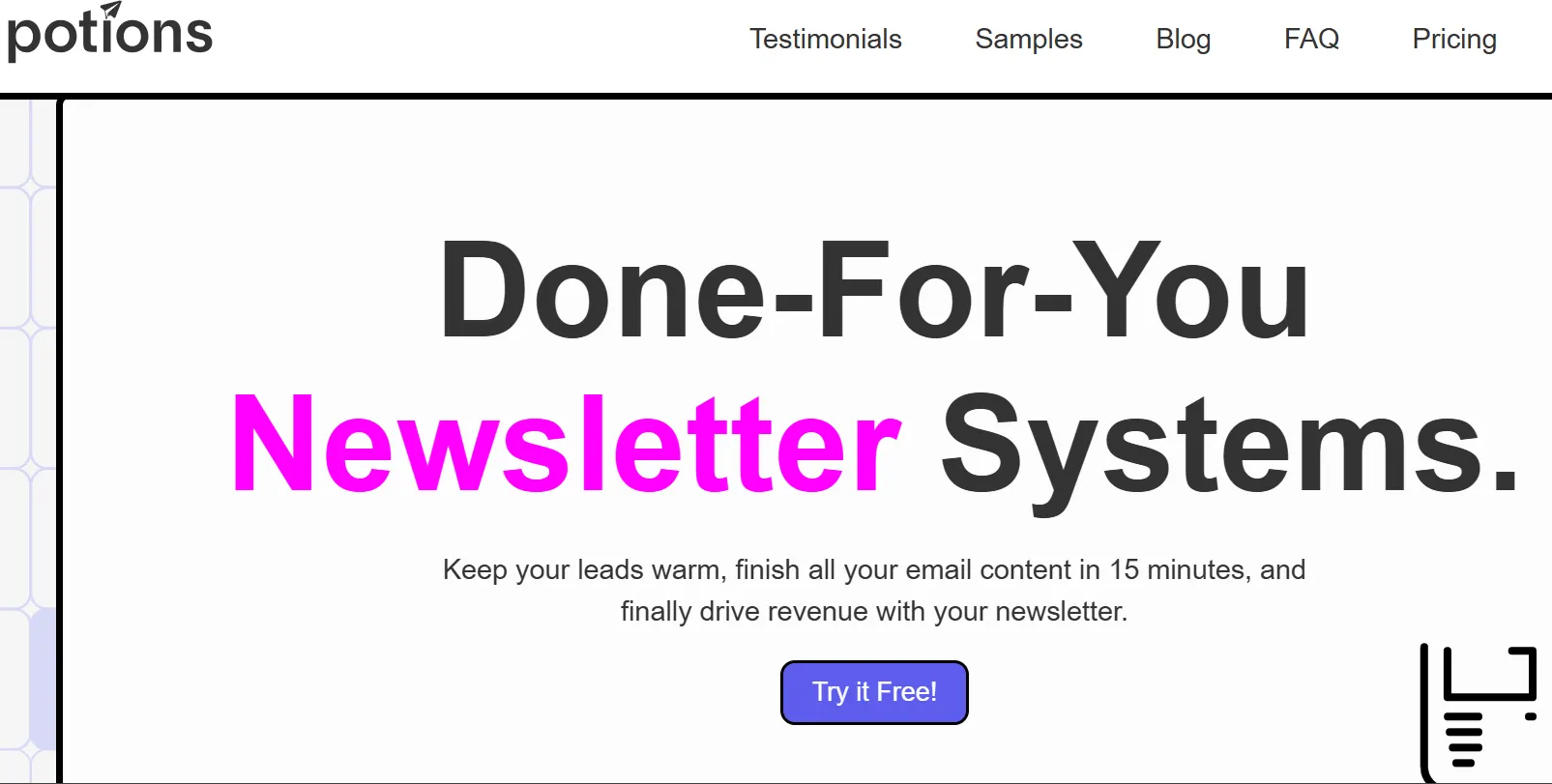
Potions sells the hard part. A team, assisted by AI, writes your newsletter each week in your voice; you review a draft and approve it; they send it and manage the list. Starting at $169 a month.
So this review isn't really "is the software good." It's a different and more interesting question: is paying someone to write in your voice a good idea, and is $169 the right price for it?
⚡ The short version
- What it is: a done-for-you newsletter service — ghostwriting, sending, and list hygiene — not a self-serve tool.
- Cost: $169/mo Starter, $242/mo Teams, custom for Power.
- The add-on to watch: list growth is billed separately at $2 per engaged subscriber, minimum $500/month.
- Genuinely cheap compared to an agency ($1,800+/mo) or a freelance writer.
- The real question isn't cost — it's whether outsourcing your voice makes sense for your kind of newsletter.
What you actually get for $169
The weekly loop is straightforward. Potions builds a template from your input during onboarding, interviews you about your business, and reads your existing site, blog, and social output to model how you write. Each week they produce an original draft. You review it. They send it.
Your time commitment is the pitch: roughly 15 minutes a week, against the 4–5 hours a serious weekly newsletter typically eats. They also handle list hygiene — pruning dead addresses, protecting sender reputation, keeping you out of the promotions tab. That last part is genuinely skilled work that most solo operators do badly or not at all, and it's underrated in their marketing.
| Plan | Price | What it adds |
|---|---|---|
| Starter | $169/mo | Weekly newsletter, onboarding calls, 24-hour support |
| Teams | $242/mo | Custom drip campaigns, integration help, bi-monthly strategy sessions |
| Power | Custom | Growth strategy, custom integrations, LinkedIn rollout |
| List growth | $2 per engaged subscriber ($500/mo minimum) |
Billed separately from the above |
Billing runs monthly, quarterly, or annually.
The add-on that changes the maths
That last row deserves more attention than Potions' marketing gives it.
Two things about that. First, the pricing model is actually defensible: paying per engaged subscriber rather than per raw signup means you're buying people who open things, not names on a list. Anyone who has bought list growth priced per signup and watched their open rate collapse will see why that's the better structure.
Second, the $500 minimum means it only makes sense above a certain scale. At $2 each, the minimum buys 250 engaged subscribers a month. If your newsletter monetises at, say, $1 per subscriber per month, that's a five-month payback per cohort — workable. If you have no clear revenue per subscriber, you're spending $6,000 a year on list growth without a way to tell whether it worked. Don't add this until you can answer what a subscriber is worth to you.
The real comparison: what else does $169 buy?
Judged as software, $169/month is expensive — Beehiiv and ConvertKit cost a fraction of that. But that's the wrong comparison, because those tools don't write anything. Judged as writing, the picture inverts sharply.
| Option | Realistic annual cost | What you still have to do |
|---|---|---|
| Newsletter agency | $21,600+ ($1,800/mo) | Strategy input, approvals |
| Freelance newsletter writer | $10,000–26,000 ($200–500/issue) | Brief them, edit, manage them, handle sending |
| Potions Starter | $2,028 | Review and approve, ~15 min/week |
| DIY on a platform | $300–1,200 + your time | Everything — realistically 4–5 hrs/week |
Run the DIY line properly and it stops looking free. Four hours a week is roughly 200 hours a year. If your time is worth $50/hour, that's $10,000 of your own labour to save $1,700 in fees. For most consultants and founders, that arithmetic is not close.
The honest caveat: DIY hours aren't purely a cost. Writing your own newsletter forces you to think, and the thinking often produces the ideas that become your actual business. That's real, and it doesn't show up in a table.
About that 42% open rate
Potions advertises average open rates above 42% and click-through around 5%, against typical industry figures nearer 20–25%. Impressive — and worth reading carefully.
Since Apple introduced Mail Privacy Protection, open rates have been substantially unreliable. Apple pre-fetches images for Mail users regardless of whether anyone read the message, which registers as an open. Depending on how much of your list is on Apple Mail, reported open rates can be inflated by a wide margin. This affects every sender, not just Potions — but it means a headline open rate is no longer strong evidence of anything.
The 5% click-through figure is the more meaningful number, because clicks require an actual human decision. It's a solid figure. I'd anchor on that one and treat the 42% as marketing.
Also worth noting: these are self-reported aggregates across their client base, with no independent verification and no visibility into how they're calculated or which clients are included. That's normal for vendor statistics. It's still not the same as evidence.
Deliverability is the part you're underpaying attention to
Potions lists list hygiene almost as an afterthought, and I'd argue it's one of the most valuable things in the package — because it's skilled work that most people do badly without realising there's a problem.
Email deliverability is not a solved problem you can ignore. Every send affects your sender reputation, and reputation determines whether future messages reach the inbox, the promotions tab, or spam. The mechanics are unforgiving: sending to addresses that no longer exist generates bounces, and a high bounce rate tells mailbox providers you're not maintaining your list. Continuing to send to subscribers who never open trains the same providers to treat your mail as unwanted. Both problems compound quietly.
The failure mode is nasty precisely because it's invisible. Your open rate declines gradually. You assume your content is getting less interesting. In reality a growing share of your list stopped seeing you months ago, and nothing in your dashboard says so. By the time it's obvious, recovering a damaged sender reputation is slow work.
Proper list hygiene means removing hard bounces promptly, suppressing long-term non-openers rather than clinging to a bigger number, authenticating your domain correctly, and warming up sending volume gradually rather than blasting a cold list. Most solo operators do none of this because they don't know it exists.
So when you evaluate Potions, don't weigh it purely on the writing. A service that keeps you in the inbox is worth real money independently of whether the prose is excellent, and it's a genuinely technical skill you'd otherwise have to learn or hire for.
Why newsletters actually die
Worth understanding before you decide whether $169 a month solves your problem, because it might be solving the wrong one.
Newsletters almost never fail because the writing wasn't good enough. They fail because they stop. The typical arc: enthusiastic first few issues, a missed week during something busy, a two-week gap, a guilty apology issue, then silence. The subscribers don't unsubscribe — they just forget who you are, and by the time you return your open rate has collapsed because nobody recognises the sender.
Consistency beats quality in this medium more decisively than in almost any other. A merely good newsletter that arrives every Tuesday without fail builds an audience. An excellent newsletter that appears unpredictably does not, because the value to a reader is partly the habit.
This reframes the purchase entirely. If you're considering Potions because you think your writing isn't strong enough, that's probably the wrong diagnosis and the money may not fix it. If you're considering it because your newsletter has died twice from lack of time, that's exactly the problem a done-for-you service solves — you're buying the guarantee that something ships every week regardless of how your month goes.
Be honest about which of those you are. The first case has cheaper solutions: a smaller format, a shorter issue, a lower bar. The second case is worth $169 a month, because the realistic alternative isn't a better newsletter — it's no newsletter at all.
The question that actually matters: should you outsource your voice?
Cost is the easy part. This is the part worth sitting with.
If your newsletter is the product, be careful. Where people subscribe because of how you think — a personal brand, a creator audience, a consultant whose reputation is their judgment — the writing isn't a deliverable, it's the relationship. Outsourcing it creates a slow drift between the person readers think they're hearing from and the person actually writing. Readers may not identify what changed, but engagement tends to tell you eventually.
If your newsletter is a channel, outsource away. A B2B SaaS product update, a law firm's monthly client note, an agency's industry roundup, an e-commerce brand's promotional send — nobody subscribed for the author's soul. They subscribed for information. Consistency and deliverability matter far more than authorship, and a service that reliably ships every week beats a founder who manages three issues and then goes quiet for a quarter.
That distinction is the single most useful filter I can give you. Potions' own vertical pages — lawyers, consultants, B2B SaaS, agencies — suggest they know exactly which side of it they sell best to.
What a good first month looks like
If you do sign up, the first month determines whether this works, and it's worth going in with a plan rather than passively receiving drafts.
Expect the early issues to need more editing than the promised fifteen minutes. The team is calibrating to your voice from interviews and your existing writing, and no amount of research gets that exactly right on the first attempt. Budget an hour a week initially and treat the extra time as an investment in calibration rather than evidence the service isn't working.
Give specific corrections rather than general reactions. "This doesn't sound like me" is unusable feedback. "I never open with a question," "I don't use exclamation marks," "cut the closing call to action" is the kind of instruction that actually changes the next draft. The quality of the output after month one is largely determined by how precise you were during it.
What I'd want to know before signing up
- Who owns the list? Get explicit confirmation you can export subscribers and leave. A list you can't take with you isn't an asset, it's a hostage.
- What happens to the archive if you cancel? Ask whether past issues stay accessible.
- How many revision rounds are included? "Review and approve" is smooth when the draft is good and expensive in time when it isn't.
- Who is actually writing? The pitch is AI plus humans. Ask what the split is, because it determines how much of your voice survives contact with the process.
- Is there a minimum term? Pricing is offered annually, quarterly, or monthly — start monthly until you've seen a few issues.
None of these are red flags. They're just the questions worth asking about any service that sits between you and your audience.
Who it's for
Good fit: B2B SaaS companies who need consistent product and industry content going out. Consultants and professional services firms with a list they've neglected for years. Agencies running newsletters for clients who want to expand the offering without hiring. Anyone whose newsletter has died twice already from lack of time — a mediocre newsletter that actually ships beats an excellent one that doesn't.
Poor fit: personal-brand creators whose subscribers come specifically for their voice. Anyone under roughly $2,000/month in revenue, where $169 is a meaningful share of income and the returns are slow. People who enjoy writing their newsletter — if it's the part of the week you like, don't pay someone to take it. And anyone hoping to add list growth without a clear number for what a subscriber is worth.
An exit plan is worth having from day one
One last thing, and it applies to any service that sits between you and your audience. Before you start, know how you would leave. Confirm you can export your subscriber list in a standard format, that you keep the archive of past issues, and that there is no minimum term holding you in place.
None of that suggests anything is wrong with Potions. It is simply the difference between a supplier and a dependency. A newsletter list is one of the few genuinely durable assets a small business owns, and you should be able to pick it up and walk at any point without negotiation.
Frequently Asked Questions
How much does Potions cost?
Starter is $169/month, Teams is $242/month, and Power is custom-priced. List growth is billed separately at $2 per engaged subscriber with a $500/month minimum, so budget for that if you plan to use it — it can nearly quadruple the entry price.
Is Potions a platform or a service?
Both, but the service is what you're paying for. Sending infrastructure is bundled, but the reason to choose Potions over Beehiiv or ConvertKit is that a team writes the content. Compare it to hiring a writer, not to buying software.
Is the content AI-generated?
It's a stated mix of AI and human writers — that combination is how the pricing stays well below agency rates. Ask about the specific split during onboarding, since it determines how much editing you'll do and how closely the output tracks your voice.
Are the 42% open rates believable?
Treat them cautiously. Apple's Mail Privacy Protection inflates open rates across the whole industry by registering pre-fetched images as opens. The 5% click-through figure is the more meaningful signal. Both are self-reported and unverified.
How much of my time does it actually take?
Potions claims about 15 minutes a week for review and approval. That's plausible when drafts land close to right, and will be considerably more in the early weeks while the team calibrates to your voice. Expect a heavier first month.
Will it sound like me?
Close, probably not exact. They interview you and study your existing writing, which gets a workable approximation for company or professional newsletters. If your audience specifically follows you for your voice, the gap will be more noticeable to them than to you.
Verdict
🏆 Our Assessment: Potions
Priced sensibly for what it is — roughly a tenth of an agency, and cheaper than a freelance writer once you count managing one. The weekly consistency is the real product, and consistency is what most newsletters die from. Just be clear-eyed about whether your newsletter is a channel or a relationship, and read the list-growth pricing before you add it.
My honest read: Potions solves a real problem for businesses whose newsletter keeps sliding down the priority list until it quietly stops. If that's you, $169/month to have something good going out every week without fail is defensible, and the alternative isn't a better newsletter — it's no newsletter.
But if you're building an audience around your own thinking, I'd write it yourself for longer than feels comfortable. Outsource the sending, the list hygiene, the design, the analytics. Keep the writing until keeping it is genuinely impossible.
Used Potions or a similar service? I'd like to hear how close the drafts landed — that's the thing no pricing page can tell you.